Amazon plans for its delivery drones to become a much more familiar sight over American neighborhoods. The retail giant plans to bring Prime Air drone delivery to nearly 500 U.S. cities and towns by the end of 2026, expanding the service about sixfold from its current footprint.
The ambitious rollout could bring ultrafast deliveries within reach of tens of millions of customers. Amazon says Prime Air can deliver eligible products in as little as 30 minutes, although most drone orders currently arrive about 60 minutes after checkout.
Prime Air currently operates from 11 locations across seven states. Those states are Arizona, Florida, Kansas, Louisiana, Michigan, Nebraska, and Texas. Current service areas include communities around Phoenix, Tampa, Kansas City, Baton Rouge, Detroit, Omaha, Houston, Dallas, San Antonio, and Waco.
The next phase will push Amazon into several major new markets. The company says Prime Air is coming soon to areas around Chicago, Cleveland, Atlanta, Syracuse, and Boise. More communities are expected to join the network before the end of the year. The expansion marks a major moment for an idea Amazon founder Jeff Bezos publicly discussed more than a decade ago.
Prime Air Can Deliver Millions of Lightweight Products
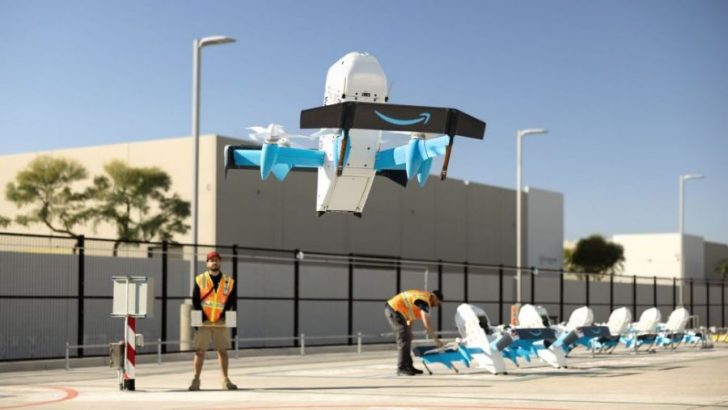
Freight Waves / Prime Air focuses on products that customers often need quickly. Amazon says its drone network can handle millions of eligible groceries, electronics, cosmetics, medications, and household goods.
Some smartphones, AirPods, AirTags, Ring doorbells, and other popular electronics also qualify.
However, there is an important size limit. Packages generally need to weigh five pounds or less and fit inside a box about the size of a large shoebox. Amazon says those requirements still cover more than 60% of the products its customers buy most frequently.
Customers also need to live close enough to a participating facility. Prime Air currently serves eligible addresses within about 7.5 miles of its delivery locations. That creates a service area of roughly 175 square miles around each site.
Ordering works much like a regular Amazon purchase. Customers shop for eligible products, choose drone delivery during checkout, and select an appropriate delivery point. The drone then carries the package to that location and releases it from above rather than landing beside the customer.
The tech giant has also set pricing low enough to encourage customers to try the service. Prime members get free drone delivery on qualifying orders worth at least $50. Prime members pay $2.99 on smaller orders, while customers without Prime pay $4.99 per drone delivery.
Amazon’s MK30 Drone Handles the Flying
Amazon relies on its MK30 aircraft for the current Prime Air service. The fully electric drone uses onboard cameras, sensors, and an automated Detect-and-Avoid system to understand its surroundings. The technology allows the aircraft to identify obstacles and make navigation decisions while flying.
Amazon says a person does not sit somewhere watching a live camera feed from each drone. The aircraft uses its onboard systems to navigate and monitor the surrounding airspace. That distinction is important as customers raise questions about privacy when delivery drones begin flying over more neighborhoods.
Nonetheless, weather will not automatically stop every flight. Amazon says its drones can operate across a range of temperatures and fly in light rain. More severe conditions can still limit operations. This makes drones less flexible than delivery vans during certain types of bad weather.
Federal regulation has played a major role in getting Prime Air this far. Amazon operates under Federal Aviation Administration Part 135 certification and has secured permission for beyond visual line of sight operations.
Safety and Competition Could Shape the Rollout
Giant / Pexels / Prime Air has faced setbacks during its long development. In October 2025, two Amazon drones collided with the boom of a crane in Tolleson, Arizona.
The incident led to investigations by the National Transportation Safety Board and the FAA. Other reported incidents have added scrutiny to the program as Amazon prepares for rapid expansion.
Real-world delivery can create less serious but still awkward problems. A recent viral video from Texas showed an Amazon drone dropping a customer’s package directly into a backyard swimming pool. Amazon said such incidents are rare, but the mishap illustrated how unusual delivery locations can test automated systems.
Walmart is also expanding drone delivery through its partnership with Alphabet’s Wing, while other companies are testing competing approaches.